
Elodie Lachaud – Exhibition & screening
Dominique Taléghani – Cartographic collages

Opening night Tuesday June 2, 2026 from 6:00 to 9:30 pm.
Meet the artists Saturday June 6, 2026 from 2:00 to 8:00 pm.
Followed by the screening of “Où allez-vous – Passenger 001 Cara Spohr Cullen”
for the Nuit Blanche from 8:30 to 10:30 pm
Elodie Lachaud
Installation – Unique prints – Videos
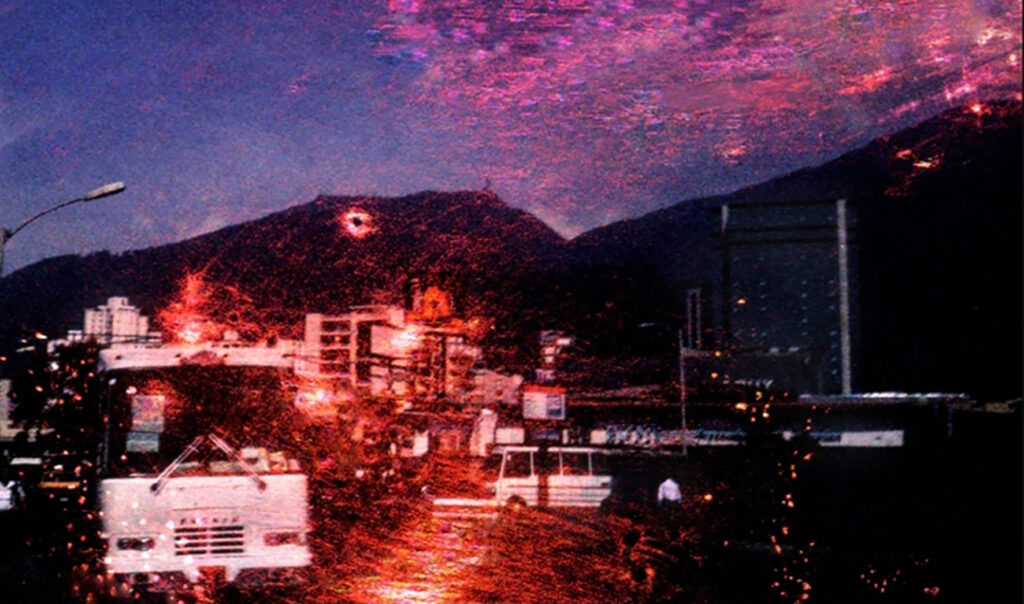
A sky crossed. Tired shoes. A disco ball somewhere between road, night and worn-out celebration.
Drift(s) gathers traces of a continuous movement — physical, emotional, mental. Images, displaced objects, fragments of road left behind to keep breathing. Élodie Lachaud’s work does not document a journey. It holds its warmth, its wear, its vibration.
Ghost car radio. Blonde on the highway at night. Engine still warm in the rear-view mirrors. Wild traffic. Heart flashing hazard lights. Slowing down was never part of the plan.
We move through. Sometimes fleeing, sometimes with no particular destination. Following a light, an interior exit ramp. This kind of circulation — feminine, nocturnal, wild — Élodie Lachaud captures and installs in the gallery space as a nocturnal transmission, a mobile chamber of truth. Nothing is fixed. Everything flows.
Nothing to declare but the vertigo.
Dominique Taléghani
Cartographic collages
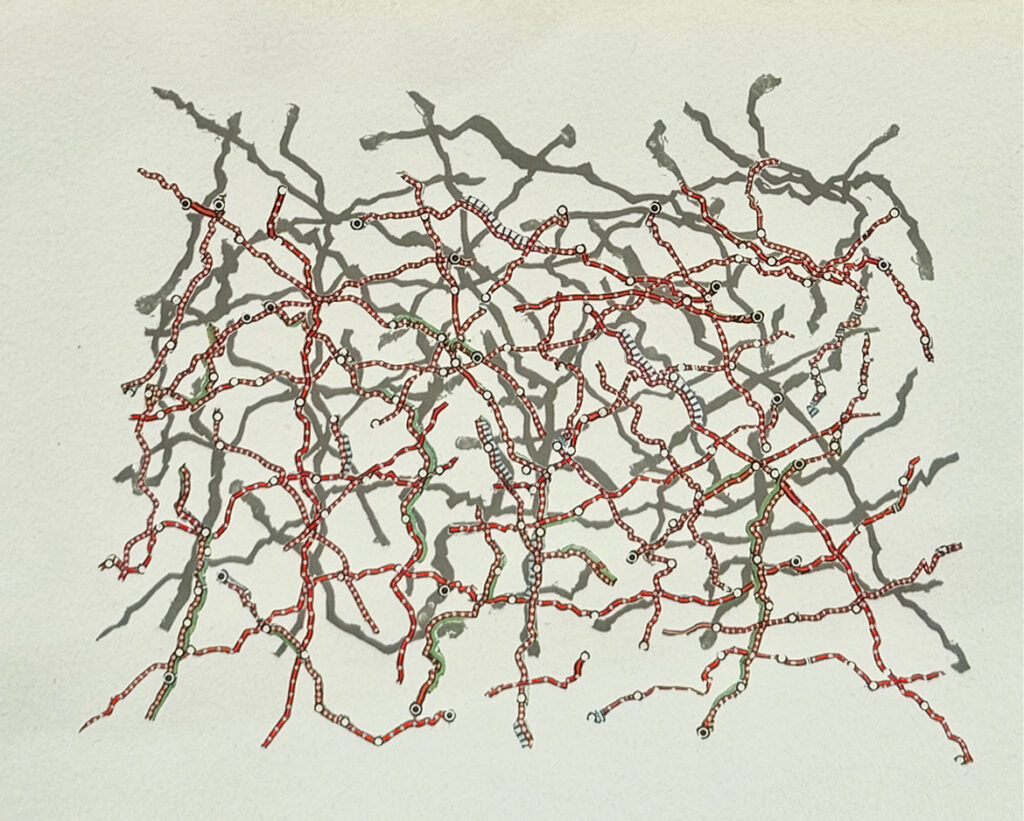
In the beginning, there were maps. Road maps from childhood, geographical atlases, globes studied for hours on end. Dominique Taléghani is a science journalist by trade, but it was a different relationship with the world that led him, one day in 2005, to act on it: cutting these territories into tiny fragments — sometimes just a square millimetre — and reassembling them into something else entirely. From this process emerge cartographismes, singular objects that shift the way we see the world and become, in turn, a surface for new reveries.
The technique is artisanal and meticulous: a cutter, a glue pen, a magnifying lamp, a cutting mat. Nothing but maps as material. This deliberate restraint forces everything to be drawn from the cartographic vocabulary itself. The grids, the flat areas of colour, the millimetre-precise lines: all of it, torn from its original purpose, becomes pictorial matter in its own right. His compositions do not reject the cartographic material — they reveal its hidden graphic richness.
But what was once a tool for navigation becomes a terrain for wandering. These are constructions where the map no longer guides, no longer reassures, but invites you to get lost. Where the atlas once promised mastery over territory, Taléghani’s collages return something more unsettling — the feeling that the world resists being contained, ordered, explained.
Drift(s) borrows from the Situationists this simple and subversive idea: that the world can be inhabited differently, that the logic of the itinerary can be replaced by that of desire. Dominique Taléghani cuts up maps to set the territory free. Élodie Lachaud throws herself into that territory headlong. Two drifts.